Blog

Learn more about payments, fintech, and how businesses like yours are growing with Swich. From practical guides to real business stories, everything here is built to help you make better decisions faster.

How Cross-Border Payments Work for Pakistani Businesses

Cross-border payments for Pakistani businesses involve sending or receiving international payments through compliant channels that handle foreign exchange, regulatory documentation, and settlement across banking networks. Whether you are importing goods, exporting services, or receiving payments from international clients, understanding how to send international payments from Pakistan through the right infrastructure determines your speed, cost, and compliance.

Why Cross-Border Payments Matter More Than Ever for Pakistan

Pakistan's international trade footprint is growing in ways that go beyond traditional merchandise exports. IT and IT-enabled services exports hit an all-time high of $4.6 billion in FY26 (Daily Independent, July 2026). Freelancer earnings alone reached $1.76 billion, a 78% jump from the previous year, with nearly 3 million freelancers now contributing 25% of all IT exports (Economy.pk, July 2026). Broadband penetration crossed 64% by early 2026 (INP WealthPK, June 2026), connecting workers in smaller cities to global clients for the first time.


On the import side, Pakistan brought in $78.5 billion worth of goods, with China alone accounting for $23.5 billion (Procurement Tactics, May 2026). Every one of those imports involves a cross-border payment to an international supplier.


The volume of money moving in and out of Pakistan for business purposes is significant and growing. But the infrastructure most Pakistani businesses use to move it has not kept pace.

How International Payments From Pakistan Actually Work

When a Pakistani business makes or receives a cross-border payment, several layers are involved.


Foreign exchange. Payments typically originate in PKR and settle in USD, EUR, GBP, CNY, or another currency. The exchange rate applied, and how many intermediaries mark it up along the way, directly impacts the cost of every transaction.


Compliance and documentation. The SBP has specific regulations governing outward and inward commercial payments. Exporters need Proceeds Realisation Certificates. Importers need trade documentation including invoices, purchase orders, and LC paperwork. Freelancers receiving international payments must route them through formal banking channels. Payment compliance for exporters is not optional, it is a regulatory requirement that determines whether funds can be repatriated and reported.


Settlement and routing. Traditional cross-border payments travel through correspondent banking networks via SWIFT. A payment from a Pakistani business to a Chinese supplier might pass through two or three intermediary banks before landing. Each one adds time and deducts fees. Settlement takes 3-5 business days, and the sender often does not know the final amount received until after the transaction completes.


Reconciliation. For businesses making regular international payments, tracking what was sent, what was received, what fees were deducted, and matching everything to invoices becomes an operational burden that grows with every transaction.

The Problems Pakistani Businesses Run Into

The most common pain points are not exotic. They are practical.


A textile exporter in Faisalabad receives payment from a European buyer, but the intermediary bank deductions mean the settled amount does not match the invoice. An e-commerce brand importing packaging from China pays through a bank wire and waits four days for confirmation while inventory sits in a port. A SaaS company in Lahore paying for AWS hosting and international marketing tools processes each payment individually through a bank portal. A freelancer agency receiving bulk payments from international clients struggles with compliance documentation because their payment channel was not designed for commercial inflows.


In each case, the business is dealing with slow settlement, opaque fees, manual processes, and compliance friction that a proper cross-border payment infrastructure would eliminate.

How Swich Handles Cross-Border Payments for Pakistani Businesses

Swich's cross-border settlement infrastructure is built for the business side of international payments.


Transparent foreign exchange. Swich provides visibility on rates and fees before the transaction processes. No hidden intermediary deductions that only show up after settlement. The business knows exactly what the recipient will receive.


Built-in compliance. Every cross-border transaction through Swich processes in full compliance with SBP's foreign exchange regulations and international AML/KYC standards. The documentation requirements, whether for exporters, importers, or service providers, are handled within the platform. Payment compliance for exporters becomes a managed process instead of a manual headache.


Faster settlement. Modern payment rails mean cross-border transactions settle significantly faster than traditional correspondent banking. Businesses are not waiting 3-5 days to confirm whether a supplier payment landed.


One platform for everything. Pakistani businesses already using Swich for domestic payment collection and corporate payouts can manage their international payment flows through the same dashboard. Brands like Dunkin Donuts, Élan, Stylo, Sveston, and Yango already run their domestic payments on Swich. Cross-border settlement is a natural extension, same platform, same reporting, same reconciliation.


PCI DSS v4.0.1 security. Every transaction, domestic or international, processes through Swich's certified environment with end-to-end encryption, multi-layered authentication, and full regulatory compliance.

Who Needs Cross-Border Payment Infrastructure in Pakistan

Importers paying international suppliers for raw materials, finished goods, or equipment. Whether sourcing from China, the UAE, Turkey, or Europe, every import requires a compliant international payment with proper documentation.


Exporters receiving payment from international buyers. Textile manufacturers, rice exporters, surgical instrument companies. Each needs structured inward settlement that complies with SBP's export repatriation requirements.


IT services companies and agencies billing international clients. With IT exports at $4.6 billion and growing 20% year on year, this segment needs scalable cross-border ecommerce payments infrastructure, not one-off bank wires.


Freelancers and freelancer agencies receiving bulk payments from platforms and direct clients abroad. Nearly 3 million Pakistani freelancers earned $1.76 billion in FY26. At this scale, the payment channel matters as much as the work itself.


E-commerce businesses selling internationally or sourcing globally. Cross-border ecommerce payments require both inbound collection from international customers and outbound settlement with international suppliers.


SaaS and tech companies paying for international services, tools, hosting, and subscriptions while potentially receiving revenue from international customers.

Why the Right Infrastructure Matters Now

Pakistan's IT exports are at an all-time high. Freelancer earnings grew 78% in a single year. International trade continues at massive scale. The SBP projects remittances alone will hit $44 billion in FY27. Money is moving across Pakistan's borders at a pace and volume that demands proper infrastructure.


Using bank wires and manual processes for cross-border business payments is the equivalent of processing website orders through phone calls. It works at low volume. It breaks at scale. And it creates compliance exposure that grows with every transaction.


Swich gives Pakistani businesses a single platform for domestic collections, corporate payouts, and international settlement. One integration. Full SBP compliance. Transparent fees. Fast settlement. The infrastructure to handle cross-border payments the way a growing business needs to.


Ready to streamline your international payments? Get started with Swich and manage domestic and cross-border payments from one platform.

Frequently Asked Questions

How do cross-border payments work for Pakistani businesses? A business sends or receives payment internationally through channels that handle foreign exchange conversion, SBP compliance, trade documentation, and settlement routing. Modern platforms like Swich automate these steps through a single integration.


How can I send international payments from Pakistan? Through SBP-compliant channels that support commercial outward payments. Swich handles foreign exchange, documentation, and routing to the recipient's bank account internationally, with transparent fees and faster settlement than traditional correspondent banking.


What compliance is required for cross-border business payments in Pakistan? The SBP requires trade documentation (invoices, purchase orders), AML/KYC verification, and proper foreign exchange routing for all commercial cross-border transactions. Exporters also need Proceeds Realisation Certificates. Swich handles compliance within its platform.


Can Swich handle both domestic and international payments? Yes. Swich is a full-stack payments platform offering domestic payment collection, corporate payouts, and cross-border settlement from one dashboard. Over 2,500 businesses already use the platform.


Is Swich secure for international transactions? Swich is PCI DSS v4.0.1 certified with end-to-end encryption, multi-layered authentication, and full compliance with both SBP regulations and international payment security standards.
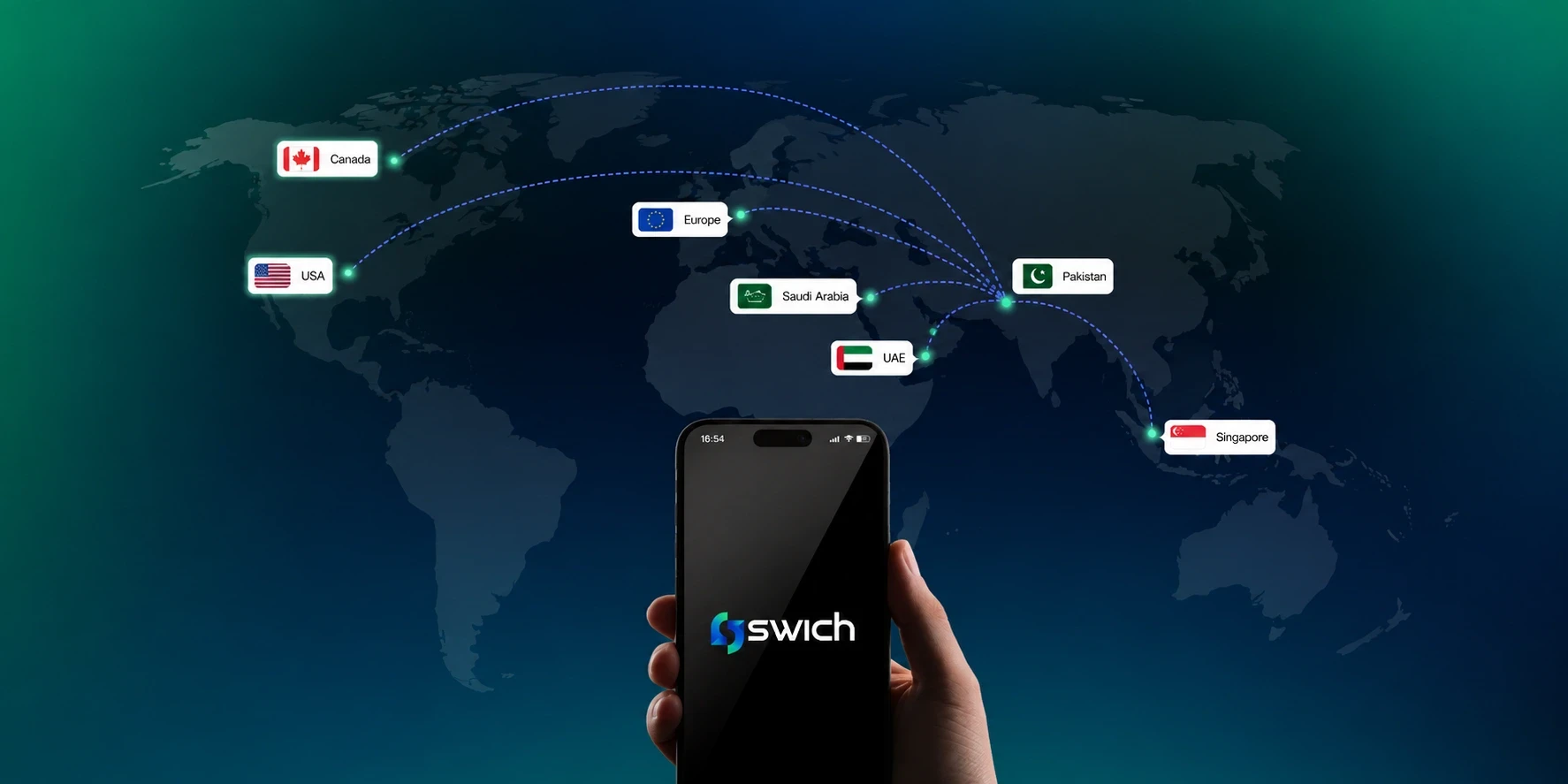
How Cross-Border Payments Work for Pakistani Businesses

Cross-border payments for Pakistani businesses involve sending or receiving international payments through compliant channels that handle foreign exchange, regulatory documentation, and settlement across banking networks. Whether you are importing goods, exporting services, or receiving payments from international clients, understanding how to send international payments from Pakistan through the right infrastructure determines your speed, cost, and compliance.

Why Cross-Border Payments Matter More Than Ever for Pakistan

Pakistan's international trade footprint is growing in ways that go beyond traditional merchandise exports. IT and IT-enabled services exports hit an all-time high of $4.6 billion in FY26 (Daily Independent, July 2026). Freelancer earnings alone reached $1.76 billion, a 78% jump from the previous year, with nearly 3 million freelancers now contributing 25% of all IT exports (Economy.pk, July 2026). Broadband penetration crossed 64% by early 2026 (INP WealthPK, June 2026), connecting workers in smaller cities to global clients for the first time.


On the import side, Pakistan brought in $78.5 billion worth of goods, with China alone accounting for $23.5 billion (Procurement Tactics, May 2026). Every one of those imports involves a cross-border payment to an international supplier.


The volume of money moving in and out of Pakistan for business purposes is significant and growing. But the infrastructure most Pakistani businesses use to move it has not kept pace.

How International Payments From Pakistan Actually Work

When a Pakistani business makes or receives a cross-border payment, several layers are involved.


Foreign exchange. Payments typically originate in PKR and settle in USD, EUR, GBP, CNY, or another currency. The exchange rate applied, and how many intermediaries mark it up along the way, directly impacts the cost of every transaction.


Compliance and documentation. The SBP has specific regulations governing outward and inward commercial payments. Exporters need Proceeds Realisation Certificates. Importers need trade documentation including invoices, purchase orders, and LC paperwork. Freelancers receiving international payments must route them through formal banking channels. Payment compliance for exporters is not optional, it is a regulatory requirement that determines whether funds can be repatriated and reported.


Settlement and routing. Traditional cross-border payments travel through correspondent banking networks via SWIFT. A payment from a Pakistani business to a Chinese supplier might pass through two or three intermediary banks before landing. Each one adds time and deducts fees. Settlement takes 3-5 business days, and the sender often does not know the final amount received until after the transaction completes.


Reconciliation. For businesses making regular international payments, tracking what was sent, what was received, what fees were deducted, and matching everything to invoices becomes an operational burden that grows with every transaction.

The Problems Pakistani Businesses Run Into

The most common pain points are not exotic. They are practical.


A textile exporter in Faisalabad receives payment from a European buyer, but the intermediary bank deductions mean the settled amount does not match the invoice. An e-commerce brand importing packaging from China pays through a bank wire and waits four days for confirmation while inventory sits in a port. A SaaS company in Lahore paying for AWS hosting and international marketing tools processes each payment individually through a bank portal. A freelancer agency receiving bulk payments from international clients struggles with compliance documentation because their payment channel was not designed for commercial inflows.


In each case, the business is dealing with slow settlement, opaque fees, manual processes, and compliance friction that a proper cross-border payment infrastructure would eliminate.

How Swich Handles Cross-Border Payments for Pakistani Businesses

Swich's cross-border settlement infrastructure is built for the business side of international payments.


Transparent foreign exchange. Swich provides visibility on rates and fees before the transaction processes. No hidden intermediary deductions that only show up after settlement. The business knows exactly what the recipient will receive.


Built-in compliance. Every cross-border transaction through Swich processes in full compliance with SBP's foreign exchange regulations and international AML/KYC standards. The documentation requirements, whether for exporters, importers, or service providers, are handled within the platform. Payment compliance for exporters becomes a managed process instead of a manual headache.


Faster settlement. Modern payment rails mean cross-border transactions settle significantly faster than traditional correspondent banking. Businesses are not waiting 3-5 days to confirm whether a supplier payment landed.


One platform for everything. Pakistani businesses already using Swich for domestic payment collection and corporate payouts can manage their international payment flows through the same dashboard. Brands like Dunkin Donuts, Élan, Stylo, Sveston, and Yango already run their domestic payments on Swich. Cross-border settlement is a natural extension, same platform, same reporting, same reconciliation.


PCI DSS v4.0.1 security. Every transaction, domestic or international, processes through Swich's certified environment with end-to-end encryption, multi-layered authentication, and full regulatory compliance.

Who Needs Cross-Border Payment Infrastructure in Pakistan

Importers paying international suppliers for raw materials, finished goods, or equipment. Whether sourcing from China, the UAE, Turkey, or Europe, every import requires a compliant international payment with proper documentation.


Exporters receiving payment from international buyers. Textile manufacturers, rice exporters, surgical instrument companies. Each needs structured inward settlement that complies with SBP's export repatriation requirements.


IT services companies and agencies billing international clients. With IT exports at $4.6 billion and growing 20% year on year, this segment needs scalable cross-border ecommerce payments infrastructure, not one-off bank wires.


Freelancers and freelancer agencies receiving bulk payments from platforms and direct clients abroad. Nearly 3 million Pakistani freelancers earned $1.76 billion in FY26. At this scale, the payment channel matters as much as the work itself.


E-commerce businesses selling internationally or sourcing globally. Cross-border ecommerce payments require both inbound collection from international customers and outbound settlement with international suppliers.


SaaS and tech companies paying for international services, tools, hosting, and subscriptions while potentially receiving revenue from international customers.

Why the Right Infrastructure Matters Now

Pakistan's IT exports are at an all-time high. Freelancer earnings grew 78% in a single year. International trade continues at massive scale. The SBP projects remittances alone will hit $44 billion in FY27. Money is moving across Pakistan's borders at a pace and volume that demands proper infrastructure.


Using bank wires and manual processes for cross-border business payments is the equivalent of processing website orders through phone calls. It works at low volume. It breaks at scale. And it creates compliance exposure that grows with every transaction.


Swich gives Pakistani businesses a single platform for domestic collections, corporate payouts, and international settlement. One integration. Full SBP compliance. Transparent fees. Fast settlement. The infrastructure to handle cross-border payments the way a growing business needs to.


Ready to streamline your international payments? Get started with Swich and manage domestic and cross-border payments from one platform.

Frequently Asked Questions

How do cross-border payments work for Pakistani businesses? A business sends or receives payment internationally through channels that handle foreign exchange conversion, SBP compliance, trade documentation, and settlement routing. Modern platforms like Swich automate these steps through a single integration.


How can I send international payments from Pakistan? Through SBP-compliant channels that support commercial outward payments. Swich handles foreign exchange, documentation, and routing to the recipient's bank account internationally, with transparent fees and faster settlement than traditional correspondent banking.


What compliance is required for cross-border business payments in Pakistan? The SBP requires trade documentation (invoices, purchase orders), AML/KYC verification, and proper foreign exchange routing for all commercial cross-border transactions. Exporters also need Proceeds Realisation Certificates. Swich handles compliance within its platform.


Can Swich handle both domestic and international payments? Yes. Swich is a full-stack payments platform offering domestic payment collection, corporate payouts, and cross-border settlement from one dashboard. Over 2,500 businesses already use the platform.


Is Swich secure for international transactions? Swich is PCI DSS v4.0.1 certified with end-to-end encryption, multi-layered authentication, and full compliance with both SBP regulations and international payment security standards.

How Cross-Border Payments Work for Pakistani Businesses

Cross-border payments for Pakistani businesses involve sending or receiving international payments through compliant channels that handle foreign exchange, regulatory documentation, and settlement across banking networks. Whether you are importing goods, exporting services, or receiving payments from international clients, understanding how to send international payments from Pakistan through the right infrastructure determines your speed, cost, and compliance.

Why Cross-Border Payments Matter More Than Ever for Pakistan

Pakistan's international trade footprint is growing in ways that go beyond traditional merchandise exports. IT and IT-enabled services exports hit an all-time high of $4.6 billion in FY26 (Daily Independent, July 2026). Freelancer earnings alone reached $1.76 billion, a 78% jump from the previous year, with nearly 3 million freelancers now contributing 25% of all IT exports (Economy.pk, July 2026). Broadband penetration crossed 64% by early 2026 (INP WealthPK, June 2026), connecting workers in smaller cities to global clients for the first time.


On the import side, Pakistan brought in $78.5 billion worth of goods, with China alone accounting for $23.5 billion (Procurement Tactics, May 2026). Every one of those imports involves a cross-border payment to an international supplier.


The volume of money moving in and out of Pakistan for business purposes is significant and growing. But the infrastructure most Pakistani businesses use to move it has not kept pace.

How International Payments From Pakistan Actually Work

When a Pakistani business makes or receives a cross-border payment, several layers are involved.


Foreign exchange. Payments typically originate in PKR and settle in USD, EUR, GBP, CNY, or another currency. The exchange rate applied, and how many intermediaries mark it up along the way, directly impacts the cost of every transaction.


Compliance and documentation. The SBP has specific regulations governing outward and inward commercial payments. Exporters need Proceeds Realisation Certificates. Importers need trade documentation including invoices, purchase orders, and LC paperwork. Freelancers receiving international payments must route them through formal banking channels. Payment compliance for exporters is not optional, it is a regulatory requirement that determines whether funds can be repatriated and reported.


Settlement and routing. Traditional cross-border payments travel through correspondent banking networks via SWIFT. A payment from a Pakistani business to a Chinese supplier might pass through two or three intermediary banks before landing. Each one adds time and deducts fees. Settlement takes 3-5 business days, and the sender often does not know the final amount received until after the transaction completes.


Reconciliation. For businesses making regular international payments, tracking what was sent, what was received, what fees were deducted, and matching everything to invoices becomes an operational burden that grows with every transaction.

The Problems Pakistani Businesses Run Into

The most common pain points are not exotic. They are practical.


A textile exporter in Faisalabad receives payment from a European buyer, but the intermediary bank deductions mean the settled amount does not match the invoice. An e-commerce brand importing packaging from China pays through a bank wire and waits four days for confirmation while inventory sits in a port. A SaaS company in Lahore paying for AWS hosting and international marketing tools processes each payment individually through a bank portal. A freelancer agency receiving bulk payments from international clients struggles with compliance documentation because their payment channel was not designed for commercial inflows.


In each case, the business is dealing with slow settlement, opaque fees, manual processes, and compliance friction that a proper cross-border payment infrastructure would eliminate.

How Swich Handles Cross-Border Payments for Pakistani Businesses

Swich's cross-border settlement infrastructure is built for the business side of international payments.


Transparent foreign exchange. Swich provides visibility on rates and fees before the transaction processes. No hidden intermediary deductions that only show up after settlement. The business knows exactly what the recipient will receive.


Built-in compliance. Every cross-border transaction through Swich processes in full compliance with SBP's foreign exchange regulations and international AML/KYC standards. The documentation requirements, whether for exporters, importers, or service providers, are handled within the platform. Payment compliance for exporters becomes a managed process instead of a manual headache.


Faster settlement. Modern payment rails mean cross-border transactions settle significantly faster than traditional correspondent banking. Businesses are not waiting 3-5 days to confirm whether a supplier payment landed.


One platform for everything. Pakistani businesses already using Swich for domestic payment collection and corporate payouts can manage their international payment flows through the same dashboard. Brands like Dunkin Donuts, Élan, Stylo, Sveston, and Yango already run their domestic payments on Swich. Cross-border settlement is a natural extension, same platform, same reporting, same reconciliation.


PCI DSS v4.0.1 security. Every transaction, domestic or international, processes through Swich's certified environment with end-to-end encryption, multi-layered authentication, and full regulatory compliance.

Who Needs Cross-Border Payment Infrastructure in Pakistan

Importers paying international suppliers for raw materials, finished goods, or equipment. Whether sourcing from China, the UAE, Turkey, or Europe, every import requires a compliant international payment with proper documentation.


Exporters receiving payment from international buyers. Textile manufacturers, rice exporters, surgical instrument companies. Each needs structured inward settlement that complies with SBP's export repatriation requirements.


IT services companies and agencies billing international clients. With IT exports at $4.6 billion and growing 20% year on year, this segment needs scalable cross-border ecommerce payments infrastructure, not one-off bank wires.


Freelancers and freelancer agencies receiving bulk payments from platforms and direct clients abroad. Nearly 3 million Pakistani freelancers earned $1.76 billion in FY26. At this scale, the payment channel matters as much as the work itself.


E-commerce businesses selling internationally or sourcing globally. Cross-border ecommerce payments require both inbound collection from international customers and outbound settlement with international suppliers.


SaaS and tech companies paying for international services, tools, hosting, and subscriptions while potentially receiving revenue from international customers.

Why the Right Infrastructure Matters Now

Pakistan's IT exports are at an all-time high. Freelancer earnings grew 78% in a single year. International trade continues at massive scale. The SBP projects remittances alone will hit $44 billion in FY27. Money is moving across Pakistan's borders at a pace and volume that demands proper infrastructure.


Using bank wires and manual processes for cross-border business payments is the equivalent of processing website orders through phone calls. It works at low volume. It breaks at scale. And it creates compliance exposure that grows with every transaction.


Swich gives Pakistani businesses a single platform for domestic collections, corporate payouts, and international settlement. One integration. Full SBP compliance. Transparent fees. Fast settlement. The infrastructure to handle cross-border payments the way a growing business needs to.


Ready to streamline your international payments? Get started with Swich and manage domestic and cross-border payments from one platform.

Frequently Asked Questions

How do cross-border payments work for Pakistani businesses? A business sends or receives payment internationally through channels that handle foreign exchange conversion, SBP compliance, trade documentation, and settlement routing. Modern platforms like Swich automate these steps through a single integration.


How can I send international payments from Pakistan? Through SBP-compliant channels that support commercial outward payments. Swich handles foreign exchange, documentation, and routing to the recipient's bank account internationally, with transparent fees and faster settlement than traditional correspondent banking.


What compliance is required for cross-border business payments in Pakistan? The SBP requires trade documentation (invoices, purchase orders), AML/KYC verification, and proper foreign exchange routing for all commercial cross-border transactions. Exporters also need Proceeds Realisation Certificates. Swich handles compliance within its platform.


Can Swich handle both domestic and international payments? Yes. Swich is a full-stack payments platform offering domestic payment collection, corporate payouts, and cross-border settlement from one dashboard. Over 2,500 businesses already use the platform.


Is Swich secure for international transactions? Swich is PCI DSS v4.0.1 certified with end-to-end encryption, multi-layered authentication, and full compliance with both SBP regulations and international payment security standards.

Payment Gateway vs Payout API: Which Does Your Business Actually Need?

A payment gateway collects money from customers. A payout API sends money to vendors, partners, and employees. One handles inbound payments, the other handles outbound disbursements. Most businesses operating at scale in Pakistan need both, but understanding which solves which problem is the first step to building the right payment infrastructure.

What Is a Payment Gateway and What Does It Do?

A payment gateway sits at your checkout. When a customer buys something on your website, the gateway processes the transaction: it captures the payment details, encrypts them, routes the request to the customer's bank or wallet provider, and confirms whether the payment went through.


For businesses looking for a payment gateway in Pakistan, this means supporting cards such as Visa and Mastercard, mobile wallets like JazzCash and Easypaisa, Raast instant transfers, and bank account payments.  A gateway that only handles one or two of these methods loses customers at the last click, which is why coverage across all major payment channels matters. Pakistan's digital payment transactions hit 9.1 billion in FY25, growing 38% year on year (Arab News, November 2025). Consumers are paying digitally. The gateway's job is to make sure your business can accept however they choose to pay.


Swich's payment gateway does exactly this. One integration, every Pakistani payment method, PCI DSS v4.0.1 certified. Brands like Dunkin Donuts, Élan, Stylo, and Sveston use it to power their website checkouts. Pre-built plugins for WooCommerce and Shopify handle standard e-commerce setups. A full RESTful API handles custom platforms.

What Is a Payout API and How Is It Different?

A payout API moves money in the opposite direction. Instead of collecting from customers, it distributes funds from your business to multiple recipients: vendors, suppliers, delivery riders, freelancers, affiliate commissions, refunds, or employee salaries.


If you're wondering what is a payout API, it is essentially a software integration that allows a business to automate payments to multiple recipients through connected banking and payment channels. Instead of processing each payment manually, businesses can initiate and track payouts programmatically


Without a payout API, this process is manual. Someone on the finance team logs into a bank portal, uploads a spreadsheet of recipients, initiates transfers one by one, and reconciles everything afterward. At 50 payments a week, it is manageable. At 500, it is a full-time job. At 5,000, it breaks.


A payout API automates the entire flow. Your system sends a request with the recipient's details, amount, and preferred payment channel. The API routes the payment, whether to a bank account via 1LINK, a JazzCash wallet, an Easypaisa account, or a Raast ID, and confirms settlement. Thousands of payments can go out in a single batch.


Swich's bulk payout API connects to every major disbursement channel in Pakistan through one integration. Companies like Yango, Khazaney, KalPay, Sunridge, JDC, and Allure Beauty already use it to process payouts at scale, from daily rider earnings to monthly vendor settlements.

Payment Gateway vs Payout API: The Core Difference

The simplest way to think about it: a payment gateway is money in, a payout API is money out.

A payment gateway answers the question "how do my customers pay me?" It sits between your customer and your business, processing the transaction when someone buys your product or service. It needs to be fast, secure, and flexible enough to support every payment method your customers use.


A payout API answers the question "how do I pay the people I owe?" It sits between your business and your recipients, automating the disbursement of funds to vendors, workers, or partners. It needs to handle volume, support multiple payout channels, reconcile automatically, and settle quickly.


A payment gateway cares about conversion. Every friction point at checkout is a lost sale. A payout API cares about operational efficiency. Every manual payment is time and money wasted. Different problems, different infrastructure, but both critical for a business that is collecting revenue and distributing it.

When You Need a Payment Gateway

If your business sells products or services online and needs to accept payments from customers, you need a payment gateway. This includes e-commerce stores on WooCommerce, Shopify, or custom platforms. Subscription and SaaS businesses collecting recurring fees. Service providers taking bookings and deposits. Any business with a website checkout or payment page.


The payment gateway is the first piece of payment infrastructure most businesses set up because without it, you cannot collect revenue digitally.

When You Need a Payout API

If your business regularly pays more than a handful of recipients, a payout API removes the manual overhead that slows operations and introduces errors. The sectors that feel this most acutely are ride hailing and delivery platforms paying drivers daily, e-commerce marketplaces settling with hundreds of sellers, fintech platforms disbursing loans or investment returns, insurance companies processing claims, HR departments running payroll across multiple entities, and any business managing vendor payments at scale.


The payout API becomes essential at the point where manual disbursement stops being annoying and starts being operationally impossible.

When You Need Both

Most businesses that scale eventually need both. You collect money through the gateway and distribute it through the payout API. An e-commerce marketplace collects from buyers and settles with sellers. A ride hailing platform charges passengers and pays drivers. A SaaS company collects subscriptions and pays affiliates or vendors.


Swich is built for this. Payment gateway and payout API on one platform, one dashboard, one integration partner. Collections, disbursements, reconciliation, and reporting all in one place. Instead of managing separate providers for inbound and outbound payments, each with their own dashboard, their own API, and their own reconciliation process, everything runs through Swich.


Over 2,500 businesses already use the platform. The same infrastructure that processes a customer's card payment on Élan's website can disburse vendor settlements for Sunridge or rider payouts for Yango. Full-stack payments, not piecemeal.


Ready to build your complete payment infrastructure? Get started with Swich and handle collections, payouts, and everything in between from one platform.

Frequently Asked Questions

What is the difference between a payment gateway and a payout API? A payment gateway collects money from customers at checkout. A payout API sends money from your business to vendors, employees, or partners. One handles inbound payments, the other handles outbound disbursements.


Does my business need both? If you collect payments from customers and regularly pay vendors, sellers, drivers, or other recipients, yes. Most businesses operating at scale need both a gateway for collections and a payout API for disbursements.


Can Swich handle both payment collection and payouts? Yes. Swich offers a payment gateway and a bulk payout API on one platform. Collections, disbursements, reconciliation, and reporting all managed from a single dashboard.


What payment methods does Swich support? Cards (Visa, Mastercard), JazzCash, Easypaisa, Raast, and bank transfers for both inbound and outbound payments. One integration, every major Pakistani payment channel.


Is Swich secure? Swich is PCI DSS v4.0.1 certified with end-to-end encryption, multi-layered authentication, and full SBP compliance for both gateway and payout transactions.


Payment Gateway vs Payout API: Which Does Your Business Actually Need?

A payment gateway collects money from customers. A payout API sends money to vendors, partners, and employees. One handles inbound payments, the other handles outbound disbursements. Most businesses operating at scale in Pakistan need both, but understanding which solves which problem is the first step to building the right payment infrastructure.

What Is a Payment Gateway and What Does It Do?

A payment gateway sits at your checkout. When a customer buys something on your website, the gateway processes the transaction: it captures the payment details, encrypts them, routes the request to the customer's bank or wallet provider, and confirms whether the payment went through.


For businesses looking for a payment gateway in Pakistan, this means supporting cards such as Visa and Mastercard, mobile wallets like JazzCash and Easypaisa, Raast instant transfers, and bank account payments.  A gateway that only handles one or two of these methods loses customers at the last click, which is why coverage across all major payment channels matters. Pakistan's digital payment transactions hit 9.1 billion in FY25, growing 38% year on year (Arab News, November 2025). Consumers are paying digitally. The gateway's job is to make sure your business can accept however they choose to pay.


Swich's payment gateway does exactly this. One integration, every Pakistani payment method, PCI DSS v4.0.1 certified. Brands like Dunkin Donuts, Élan, Stylo, and Sveston use it to power their website checkouts. Pre-built plugins for WooCommerce and Shopify handle standard e-commerce setups. A full RESTful API handles custom platforms.

What Is a Payout API and How Is It Different?

A payout API moves money in the opposite direction. Instead of collecting from customers, it distributes funds from your business to multiple recipients: vendors, suppliers, delivery riders, freelancers, affiliate commissions, refunds, or employee salaries.


If you're wondering what is a payout API, it is essentially a software integration that allows a business to automate payments to multiple recipients through connected banking and payment channels. Instead of processing each payment manually, businesses can initiate and track payouts programmatically


Without a payout API, this process is manual. Someone on the finance team logs into a bank portal, uploads a spreadsheet of recipients, initiates transfers one by one, and reconciles everything afterward. At 50 payments a week, it is manageable. At 500, it is a full-time job. At 5,000, it breaks.


A payout API automates the entire flow. Your system sends a request with the recipient's details, amount, and preferred payment channel. The API routes the payment, whether to a bank account via 1LINK, a JazzCash wallet, an Easypaisa account, or a Raast ID, and confirms settlement. Thousands of payments can go out in a single batch.


Swich's bulk payout API connects to every major disbursement channel in Pakistan through one integration. Companies like Yango, Khazaney, KalPay, Sunridge, JDC, and Allure Beauty already use it to process payouts at scale, from daily rider earnings to monthly vendor settlements.

Payment Gateway vs Payout API: The Core Difference

The simplest way to think about it: a payment gateway is money in, a payout API is money out.

A payment gateway answers the question "how do my customers pay me?" It sits between your customer and your business, processing the transaction when someone buys your product or service. It needs to be fast, secure, and flexible enough to support every payment method your customers use.


A payout API answers the question "how do I pay the people I owe?" It sits between your business and your recipients, automating the disbursement of funds to vendors, workers, or partners. It needs to handle volume, support multiple payout channels, reconcile automatically, and settle quickly.


A payment gateway cares about conversion. Every friction point at checkout is a lost sale. A payout API cares about operational efficiency. Every manual payment is time and money wasted. Different problems, different infrastructure, but both critical for a business that is collecting revenue and distributing it.

When You Need a Payment Gateway

If your business sells products or services online and needs to accept payments from customers, you need a payment gateway. This includes e-commerce stores on WooCommerce, Shopify, or custom platforms. Subscription and SaaS businesses collecting recurring fees. Service providers taking bookings and deposits. Any business with a website checkout or payment page.


The payment gateway is the first piece of payment infrastructure most businesses set up because without it, you cannot collect revenue digitally.

When You Need a Payout API

If your business regularly pays more than a handful of recipients, a payout API removes the manual overhead that slows operations and introduces errors. The sectors that feel this most acutely are ride hailing and delivery platforms paying drivers daily, e-commerce marketplaces settling with hundreds of sellers, fintech platforms disbursing loans or investment returns, insurance companies processing claims, HR departments running payroll across multiple entities, and any business managing vendor payments at scale.


The payout API becomes essential at the point where manual disbursement stops being annoying and starts being operationally impossible.

When You Need Both

Most businesses that scale eventually need both. You collect money through the gateway and distribute it through the payout API. An e-commerce marketplace collects from buyers and settles with sellers. A ride hailing platform charges passengers and pays drivers. A SaaS company collects subscriptions and pays affiliates or vendors.


Swich is built for this. Payment gateway and payout API on one platform, one dashboard, one integration partner. Collections, disbursements, reconciliation, and reporting all in one place. Instead of managing separate providers for inbound and outbound payments, each with their own dashboard, their own API, and their own reconciliation process, everything runs through Swich.


Over 2,500 businesses already use the platform. The same infrastructure that processes a customer's card payment on Élan's website can disburse vendor settlements for Sunridge or rider payouts for Yango. Full-stack payments, not piecemeal.


Ready to build your complete payment infrastructure? Get started with Swich and handle collections, payouts, and everything in between from one platform.

Frequently Asked Questions

What is the difference between a payment gateway and a payout API? A payment gateway collects money from customers at checkout. A payout API sends money from your business to vendors, employees, or partners. One handles inbound payments, the other handles outbound disbursements.


Does my business need both? If you collect payments from customers and regularly pay vendors, sellers, drivers, or other recipients, yes. Most businesses operating at scale need both a gateway for collections and a payout API for disbursements.


Can Swich handle both payment collection and payouts? Yes. Swich offers a payment gateway and a bulk payout API on one platform. Collections, disbursements, reconciliation, and reporting all managed from a single dashboard.


What payment methods does Swich support? Cards (Visa, Mastercard), JazzCash, Easypaisa, Raast, and bank transfers for both inbound and outbound payments. One integration, every major Pakistani payment channel.


Is Swich secure? Swich is PCI DSS v4.0.1 certified with end-to-end encryption, multi-layered authentication, and full SBP compliance for both gateway and payout transactions.


Payment Gateway vs Payout API: Which Does Your Business Actually Need?

A payment gateway collects money from customers. A payout API sends money to vendors, partners, and employees. One handles inbound payments, the other handles outbound disbursements. Most businesses operating at scale in Pakistan need both, but understanding which solves which problem is the first step to building the right payment infrastructure.

What Is a Payment Gateway and What Does It Do?

A payment gateway sits at your checkout. When a customer buys something on your website, the gateway processes the transaction: it captures the payment details, encrypts them, routes the request to the customer's bank or wallet provider, and confirms whether the payment went through.


For businesses looking for a payment gateway in Pakistan, this means supporting cards such as Visa and Mastercard, mobile wallets like JazzCash and Easypaisa, Raast instant transfers, and bank account payments.  A gateway that only handles one or two of these methods loses customers at the last click, which is why coverage across all major payment channels matters. Pakistan's digital payment transactions hit 9.1 billion in FY25, growing 38% year on year (Arab News, November 2025). Consumers are paying digitally. The gateway's job is to make sure your business can accept however they choose to pay.


Swich's payment gateway does exactly this. One integration, every Pakistani payment method, PCI DSS v4.0.1 certified. Brands like Dunkin Donuts, Élan, Stylo, and Sveston use it to power their website checkouts. Pre-built plugins for WooCommerce and Shopify handle standard e-commerce setups. A full RESTful API handles custom platforms.

What Is a Payout API and How Is It Different?

A payout API moves money in the opposite direction. Instead of collecting from customers, it distributes funds from your business to multiple recipients: vendors, suppliers, delivery riders, freelancers, affiliate commissions, refunds, or employee salaries.


If you're wondering what is a payout API, it is essentially a software integration that allows a business to automate payments to multiple recipients through connected banking and payment channels. Instead of processing each payment manually, businesses can initiate and track payouts programmatically


Without a payout API, this process is manual. Someone on the finance team logs into a bank portal, uploads a spreadsheet of recipients, initiates transfers one by one, and reconciles everything afterward. At 50 payments a week, it is manageable. At 500, it is a full-time job. At 5,000, it breaks.


A payout API automates the entire flow. Your system sends a request with the recipient's details, amount, and preferred payment channel. The API routes the payment, whether to a bank account via 1LINK, a JazzCash wallet, an Easypaisa account, or a Raast ID, and confirms settlement. Thousands of payments can go out in a single batch.


Swich's bulk payout API connects to every major disbursement channel in Pakistan through one integration. Companies like Yango, Khazaney, KalPay, Sunridge, JDC, and Allure Beauty already use it to process payouts at scale, from daily rider earnings to monthly vendor settlements.

Payment Gateway vs Payout API: The Core Difference

The simplest way to think about it: a payment gateway is money in, a payout API is money out.

A payment gateway answers the question "how do my customers pay me?" It sits between your customer and your business, processing the transaction when someone buys your product or service. It needs to be fast, secure, and flexible enough to support every payment method your customers use.


A payout API answers the question "how do I pay the people I owe?" It sits between your business and your recipients, automating the disbursement of funds to vendors, workers, or partners. It needs to handle volume, support multiple payout channels, reconcile automatically, and settle quickly.


A payment gateway cares about conversion. Every friction point at checkout is a lost sale. A payout API cares about operational efficiency. Every manual payment is time and money wasted. Different problems, different infrastructure, but both critical for a business that is collecting revenue and distributing it.

When You Need a Payment Gateway

If your business sells products or services online and needs to accept payments from customers, you need a payment gateway. This includes e-commerce stores on WooCommerce, Shopify, or custom platforms. Subscription and SaaS businesses collecting recurring fees. Service providers taking bookings and deposits. Any business with a website checkout or payment page.


The payment gateway is the first piece of payment infrastructure most businesses set up because without it, you cannot collect revenue digitally.

When You Need a Payout API

If your business regularly pays more than a handful of recipients, a payout API removes the manual overhead that slows operations and introduces errors. The sectors that feel this most acutely are ride hailing and delivery platforms paying drivers daily, e-commerce marketplaces settling with hundreds of sellers, fintech platforms disbursing loans or investment returns, insurance companies processing claims, HR departments running payroll across multiple entities, and any business managing vendor payments at scale.


The payout API becomes essential at the point where manual disbursement stops being annoying and starts being operationally impossible.

When You Need Both

Most businesses that scale eventually need both. You collect money through the gateway and distribute it through the payout API. An e-commerce marketplace collects from buyers and settles with sellers. A ride hailing platform charges passengers and pays drivers. A SaaS company collects subscriptions and pays affiliates or vendors.


Swich is built for this. Payment gateway and payout API on one platform, one dashboard, one integration partner. Collections, disbursements, reconciliation, and reporting all in one place. Instead of managing separate providers for inbound and outbound payments, each with their own dashboard, their own API, and their own reconciliation process, everything runs through Swich.


Over 2,500 businesses already use the platform. The same infrastructure that processes a customer's card payment on Élan's website can disburse vendor settlements for Sunridge or rider payouts for Yango. Full-stack payments, not piecemeal.


Ready to build your complete payment infrastructure? Get started with Swich and handle collections, payouts, and everything in between from one platform.

Frequently Asked Questions

What is the difference between a payment gateway and a payout API? A payment gateway collects money from customers at checkout. A payout API sends money from your business to vendors, employees, or partners. One handles inbound payments, the other handles outbound disbursements.


Does my business need both? If you collect payments from customers and regularly pay vendors, sellers, drivers, or other recipients, yes. Most businesses operating at scale need both a gateway for collections and a payout API for disbursements.


Can Swich handle both payment collection and payouts? Yes. Swich offers a payment gateway and a bulk payout API on one platform. Collections, disbursements, reconciliation, and reporting all managed from a single dashboard.


What payment methods does Swich support? Cards (Visa, Mastercard), JazzCash, Easypaisa, Raast, and bank transfers for both inbound and outbound payments. One integration, every major Pakistani payment channel.


Is Swich secure? Swich is PCI DSS v4.0.1 certified with end-to-end encryption, multi-layered authentication, and full SBP compliance for both gateway and payout transactions.


Remittances vs B2B Cross-Border Settlement: The Difference Merchants Need to Know

Remittances are personal transfers, an overseas worker sending money home to family. B2B cross-border settlement is how businesses pay international suppliers, vendors, and partners. Both move money across borders, but they serve different purposes, follow different regulations, and need different infrastructure. If you're a Pakistani merchant handling cross-border payment in Pakistan for your business, making or receiving international payments, using the wrong channel costs you time, money, and compliance exposure.

Why Pakistani Businesses Confuse the Two

Pakistan received $41.6 billion in remittances in FY26, up 9% from $38.3 billion in FY25 (The News, July 2026). That figure is roughly 20 times the country's annual foreign direct investment and exceeds total merchandise exports of $30 billion.


Because remittances dominate Pakistan's cross-border conversation, many business owners default to the same channels when making commercial payments. A manufacturer paying a Chinese supplier, an e-commerce brand receiving settlement from an international marketplace, a SaaS company paying for cloud hosting abroad. These are all B2B cross-border settlement cases, but they frequently get routed through remittance channels because the remittance vs cross-border payments distinction isn't well understood. The result is slower settlement, higher costs, and compliance gaps that compound as the business scales.

How Cross-Border Payments Actually Work: Remittances vs B2B

The simple version: remittances move small to medium amounts between individuals through services like Western Union, bank remittance portals, or mobile wallets. Documentation is minimal. Speed is fast. The purpose is personal financial support.


B2B cross-border settlement moves larger amounts between businesses through SWIFT, correspondent banking, or modern fintech payment platforms. It requires trade documentation, invoices, contracts, foreign exchange management, and full compliance with SBP's commercial payment regulations and international AML/KYC standards. Settlement through traditional banking takes 3-5 business days, with each intermediary bank adding fees that the sender often cannot see upfront.


Globally, B2B transactions account for 72.8% of all cross-border payment revenue (Grand View Research, June 2026). The B2B cross-border market hit $31.7 trillion in 2024 and is projected to reach $47.8 trillion by 2032 (FXC Intelligence, December 2025). This is not a niche. It is the majority of how money moves internationally, and it requires infrastructure built specifically for commercial transactions.

How Swich Handles B2B Cross-Border Settlement for Pakistani Merchants

Swich's cross-border payment infrastructure is built for the business side of international payments. While remittance corridors serve individuals, Swich serves merchants who need international payment settlement for businesses as part of their operations.


Multi-currency settlement with transparent FX rates, no hidden intermediary deductions. SBP-compliant documentation and AML/KYC handled within the platform. Settlement faster than traditional correspondent banking. And all of it managed alongside domestic international merchant payments collection and corporate payouts on the same dashboard. Brands like Dunkin Donuts, Élan, Stylo, and Yango already use Swich for their domestic payments. Cross-border settlement is a natural extension of the same infrastructure, PCI DSS v4.0.1 certified with end-to-end encryption.


Whether you are importing goods, paying international service providers, receiving marketplace settlements from abroad, or collecting payment from international clients, Swich gives you a proper B2B payment channel instead of a remittance workaround.

Why Getting This Right Matters Now

The SBP projects $44 billion in remittances for FY27 (Pakistan Gulf Economist, July 2026). The personal side of cross-border payments in Pakistan is thriving. But as more Pakistani businesses trade internationally, source globally, and sell to overseas customers, the B2B side needs its own infrastructure.


Using remittance channels for business payments does not scale. It creates compliance gaps, lacks proper documentation, and offers no transparency on fees. Businesses that set up proper international payment settlement now will operate faster, cleaner, and with fewer regulatory risks as they grow.


Ready to handle your international business payments properly? Get started with Swich and manage domestic collections, payouts, and cross-border settlement from one platform.

Frequently Asked Questions

What is the difference between remittances and B2B cross-border payments? Remittances are personal transfers from individuals to family. B2B cross-border payments are commercial transactions between businesses, like paying suppliers, receiving marketplace settlements, or settling invoices with overseas partners.


Can I use remittance channels for business payments? Remittance infrastructure is not designed for commercial transactions. It lacks trade documentation, compliance frameworks, and fee transparency needed for business use. Using it creates regulatory risk as you scale.


How does Swich handle cross-border payments? Swich processes international settlement with multi-currency support, transparent FX, SBP-compliant documentation, and fast settlement, all integrated with domestic payment collection and payouts on one platform.


Is Swich secure for international payments? Swich is PCI DSS v4.0.1 certified with end-to-end encryption, multi-layered authentication, and full compliance with SBP regulations and international payment security standards.



Remittances vs B2B Cross-Border Settlement: The Difference Merchants Need to Know

Remittances are personal transfers, an overseas worker sending money home to family. B2B cross-border settlement is how businesses pay international suppliers, vendors, and partners. Both move money across borders, but they serve different purposes, follow different regulations, and need different infrastructure. If you're a Pakistani merchant handling cross-border payment in Pakistan for your business, making or receiving international payments, using the wrong channel costs you time, money, and compliance exposure.

Why Pakistani Businesses Confuse the Two

Pakistan received $41.6 billion in remittances in FY26, up 9% from $38.3 billion in FY25 (The News, July 2026). That figure is roughly 20 times the country's annual foreign direct investment and exceeds total merchandise exports of $30 billion.


Because remittances dominate Pakistan's cross-border conversation, many business owners default to the same channels when making commercial payments. A manufacturer paying a Chinese supplier, an e-commerce brand receiving settlement from an international marketplace, a SaaS company paying for cloud hosting abroad. These are all B2B cross-border settlement cases, but they frequently get routed through remittance channels because the remittance vs cross-border payments distinction isn't well understood. The result is slower settlement, higher costs, and compliance gaps that compound as the business scales.

How Cross-Border Payments Actually Work: Remittances vs B2B

The simple version: remittances move small to medium amounts between individuals through services like Western Union, bank remittance portals, or mobile wallets. Documentation is minimal. Speed is fast. The purpose is personal financial support.


B2B cross-border settlement moves larger amounts between businesses through SWIFT, correspondent banking, or modern fintech payment platforms. It requires trade documentation, invoices, contracts, foreign exchange management, and full compliance with SBP's commercial payment regulations and international AML/KYC standards. Settlement through traditional banking takes 3-5 business days, with each intermediary bank adding fees that the sender often cannot see upfront.


Globally, B2B transactions account for 72.8% of all cross-border payment revenue (Grand View Research, June 2026). The B2B cross-border market hit $31.7 trillion in 2024 and is projected to reach $47.8 trillion by 2032 (FXC Intelligence, December 2025). This is not a niche. It is the majority of how money moves internationally, and it requires infrastructure built specifically for commercial transactions.

How Swich Handles B2B Cross-Border Settlement for Pakistani Merchants

Swich's cross-border payment infrastructure is built for the business side of international payments. While remittance corridors serve individuals, Swich serves merchants who need international payment settlement for businesses as part of their operations.


Multi-currency settlement with transparent FX rates, no hidden intermediary deductions. SBP-compliant documentation and AML/KYC handled within the platform. Settlement faster than traditional correspondent banking. And all of it managed alongside domestic international merchant payments collection and corporate payouts on the same dashboard. Brands like Dunkin Donuts, Élan, Stylo, and Yango already use Swich for their domestic payments. Cross-border settlement is a natural extension of the same infrastructure, PCI DSS v4.0.1 certified with end-to-end encryption.


Whether you are importing goods, paying international service providers, receiving marketplace settlements from abroad, or collecting payment from international clients, Swich gives you a proper B2B payment channel instead of a remittance workaround.

Why Getting This Right Matters Now

The SBP projects $44 billion in remittances for FY27 (Pakistan Gulf Economist, July 2026). The personal side of cross-border payments in Pakistan is thriving. But as more Pakistani businesses trade internationally, source globally, and sell to overseas customers, the B2B side needs its own infrastructure.


Using remittance channels for business payments does not scale. It creates compliance gaps, lacks proper documentation, and offers no transparency on fees. Businesses that set up proper international payment settlement now will operate faster, cleaner, and with fewer regulatory risks as they grow.


Ready to handle your international business payments properly? Get started with Swich and manage domestic collections, payouts, and cross-border settlement from one platform.

Frequently Asked Questions

What is the difference between remittances and B2B cross-border payments? Remittances are personal transfers from individuals to family. B2B cross-border payments are commercial transactions between businesses, like paying suppliers, receiving marketplace settlements, or settling invoices with overseas partners.


Can I use remittance channels for business payments? Remittance infrastructure is not designed for commercial transactions. It lacks trade documentation, compliance frameworks, and fee transparency needed for business use. Using it creates regulatory risk as you scale.


How does Swich handle cross-border payments? Swich processes international settlement with multi-currency support, transparent FX, SBP-compliant documentation, and fast settlement, all integrated with domestic payment collection and payouts on one platform.


Is Swich secure for international payments? Swich is PCI DSS v4.0.1 certified with end-to-end encryption, multi-layered authentication, and full compliance with SBP regulations and international payment security standards.


Remittances vs B2B Cross-Border Settlement: The Difference Merchants Need to Know

Remittances are personal transfers, an overseas worker sending money home to family. B2B cross-border settlement is how businesses pay international suppliers, vendors, and partners. Both move money across borders, but they serve different purposes, follow different regulations, and need different infrastructure. If you're a Pakistani merchant handling cross-border payment in Pakistan for your business, making or receiving international payments, using the wrong channel costs you time, money, and compliance exposure.

Why Pakistani Businesses Confuse the Two

Pakistan received $41.6 billion in remittances in FY26, up 9% from $38.3 billion in FY25 (The News, July 2026). That figure is roughly 20 times the country's annual foreign direct investment and exceeds total merchandise exports of $30 billion.


Because remittances dominate Pakistan's cross-border conversation, many business owners default to the same channels when making commercial payments. A manufacturer paying a Chinese supplier, an e-commerce brand receiving settlement from an international marketplace, a SaaS company paying for cloud hosting abroad. These are all B2B cross-border settlement cases, but they frequently get routed through remittance channels because the remittance vs cross-border payments distinction isn't well understood. The result is slower settlement, higher costs, and compliance gaps that compound as the business scales.

How Cross-Border Payments Actually Work: Remittances vs B2B

The simple version: remittances move small to medium amounts between individuals through services like Western Union, bank remittance portals, or mobile wallets. Documentation is minimal. Speed is fast. The purpose is personal financial support.


B2B cross-border settlement moves larger amounts between businesses through SWIFT, correspondent banking, or modern fintech payment platforms. It requires trade documentation, invoices, contracts, foreign exchange management, and full compliance with SBP's commercial payment regulations and international AML/KYC standards. Settlement through traditional banking takes 3-5 business days, with each intermediary bank adding fees that the sender often cannot see upfront.


Globally, B2B transactions account for 72.8% of all cross-border payment revenue (Grand View Research, June 2026). The B2B cross-border market hit $31.7 trillion in 2024 and is projected to reach $47.8 trillion by 2032 (FXC Intelligence, December 2025). This is not a niche. It is the majority of how money moves internationally, and it requires infrastructure built specifically for commercial transactions.

How Swich Handles B2B Cross-Border Settlement for Pakistani Merchants

Swich's cross-border payment infrastructure is built for the business side of international payments. While remittance corridors serve individuals, Swich serves merchants who need international payment settlement for businesses as part of their operations.


Multi-currency settlement with transparent FX rates, no hidden intermediary deductions. SBP-compliant documentation and AML/KYC handled within the platform. Settlement faster than traditional correspondent banking. And all of it managed alongside domestic international merchant payments collection and corporate payouts on the same dashboard. Brands like Dunkin Donuts, Élan, Stylo, and Yango already use Swich for their domestic payments. Cross-border settlement is a natural extension of the same infrastructure, PCI DSS v4.0.1 certified with end-to-end encryption.


Whether you are importing goods, paying international service providers, receiving marketplace settlements from abroad, or collecting payment from international clients, Swich gives you a proper B2B payment channel instead of a remittance workaround.

Why Getting This Right Matters Now

The SBP projects $44 billion in remittances for FY27 (Pakistan Gulf Economist, July 2026). The personal side of cross-border payments in Pakistan is thriving. But as more Pakistani businesses trade internationally, source globally, and sell to overseas customers, the B2B side needs its own infrastructure.


Using remittance channels for business payments does not scale. It creates compliance gaps, lacks proper documentation, and offers no transparency on fees. Businesses that set up proper international payment settlement now will operate faster, cleaner, and with fewer regulatory risks as they grow.


Ready to handle your international business payments properly? Get started with Swich and manage domestic collections, payouts, and cross-border settlement from one platform.

Frequently Asked Questions

What is the difference between remittances and B2B cross-border payments? Remittances are personal transfers from individuals to family. B2B cross-border payments are commercial transactions between businesses, like paying suppliers, receiving marketplace settlements, or settling invoices with overseas partners.


Can I use remittance channels for business payments? Remittance infrastructure is not designed for commercial transactions. It lacks trade documentation, compliance frameworks, and fee transparency needed for business use. Using it creates regulatory risk as you scale.


How does Swich handle cross-border payments? Swich processes international settlement with multi-currency support, transparent FX, SBP-compliant documentation, and fast settlement, all integrated with domestic payment collection and payouts on one platform.


Is Swich secure for international payments? Swich is PCI DSS v4.0.1 certified with end-to-end encryption, multi-layered authentication, and full compliance with SBP regulations and international payment security standards.


Instant settlements. Every channel. One integration.

© Copyright 2026 swichnow.io All Rights Reserved

A brand by Numbers Pvt Ltd

Instant settlements. Every channel. One integration.

© Copyright 2026 swichnow.io All Rights Reserved

A brand by Numbers Pvt Ltd

Instant settlements. Every channel. One integration.

© Copyright 2026 swichnow.io All Rights Reserved

A brand by Numbers Pvt Ltd

Instant settlements. Every channel. One integration.

© Copyright 2026 swichnow.io All Rights Reserved

A brand by Numbers Pvt Ltd